

By Salena Poussard, owner of Good Light Marketing. Last updated October 30, 2026.
If you’re paying someone for SEO, you should know what they’re doing, why they’re doing it, and whether it’s helping your business.
I’ve talked with Maine business owners who are spending thousands of dollars a month on marketing, receiving reports full of keyword rankings and clicks, and still wondering whether it’s bringing in business.
I understand the frustration. You’re busy running a company, managing employees, and taking care of customers. You shouldn’t have to learn an entirely new industry just to figure out whether the person you’re paying is doing their job.
After more than 10 years working in digital marketing, one thing I’ve learned is that good SEO doesn’t have to be complicated to explain.
And now that people are using AI tools like ChatGPT alongside Google to research businesses, it’s worth making sure your SEO provider understands how search is changing, too.
Here’s what I think contractors should actually expect from their SEO provider.
What should local SEO for contractors include?
Local SEO for contractors generally involves improving your website, maintaining accurate business information, creating useful content, and making sure search engines can understand your services and locations.
For an insulation company, that might mean appearing when someone searches “residential insulation in Lewiston, Maine.”
For an HVAC company, it could mean answering a homeowner’s question like, “Will a heat pump heat my whole house when it’s below zero?”
The second example is especially relevant as people increasingly use conversational searches and AI tools to research their options.
Good SEO isn’t just about getting your website to appear for a particular keyword. It’s about making sure the right customers can find useful information about your business.
But that doesn’t mean every contractor needs the same monthly package.
A company with an established website and strong local visibility may only need occasional improvements. A newer business with missing service pages and an incomplete Google Business Profile may have quite a bit of work to do upfront.
The first step should be figuring out what your business actually needs, not automatically signing you up for a monthly retainer.
What should you check before paying for more SEO?
Before investing in additional SEO, I’d start by looking at how customers currently find your business, what your website is already doing well, and where there are opportunities to improve.
Are people finding you through Google? Are they calling from your Google Business Profile? Are you getting referrals? Do certain services bring in more profitable jobs than others?
Then I’d look at your existing website and search data.
That might include:
- Google Search Console: Which searches are bringing people to your website, and which pages are appearing in Google?
- Google Analytics: How are visitors finding and using your website?
- Google Business Profile: Is your information accurate, and are customers interacting with your listing?
- Your website: Do you have useful pages for your most important services? Are there technical problems preventing Google from accessing them?
- Past marketing work: What has already been done, and what results can reasonably be connected to it?
I’d also check something that gets overlooked: who actually controls your website and marketing accounts?
It’s not unusual for a business to rely on its website provider for updates. But you should still understand what access you have and what happens if you decide to work with someone else.
You should have appropriate ownership and administrative access to your website, domain, Google Business Profile, Search Console, and Analytics. Your marketing provider can have the access they need without controlling everything on your behalf.
If you’re not sure who owns those accounts, that’s a good place to start.
What actual SEO work should you be paying for each month?
Monthly SEO work might include improving service pages, creating useful content, reviewing local business information, and addressing website issues.
But the work should depend on your business goals, not just a list of tasks included in a standard package.
A monthly SEO report isn’t the same thing as monthly SEO work. Reporting is important, but you should also know what someone actually improved.
Here are some examples of work that may be worth paying for.
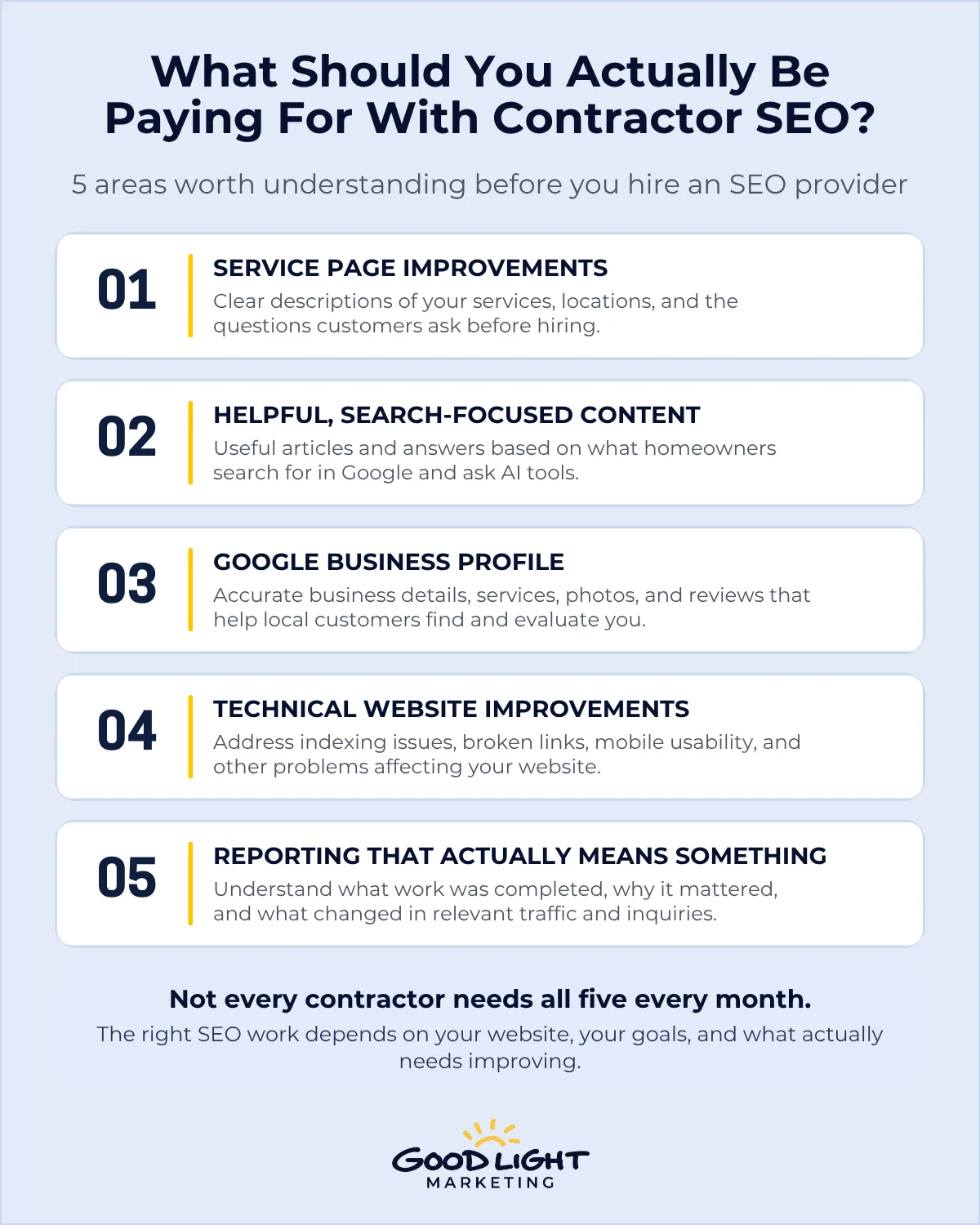
1. Improving the service pages that bring in the jobs you want
Your service pages should clearly explain what you offer, who the service is for, and why someone might need it.
Let’s say you own an insulation company. You offer several different types of insulation, but you’d really like to book more spray foam projects.
Your website should make it easy for customers and search engines to understand that service.
That could mean improving an existing page with clearer explanations, project photos, information about the process, and answers to questions customers regularly ask.
The goal isn’t to repeat “spray foam insulation Maine” as many times as possible. It’s to create a page that genuinely helps someone considering that service.
2. Creating useful content based on real customer questions
Some of the best blog topics are questions contractors already answer every week.
For example:
- Will a heat pump heat my whole house when it’s below zero?
- How often should I have my gutters cleaned?
- Is it better to repair or replace an old deck?
- Can I paint my house exterior in October in Maine?
- How long does a typical kitchen renovation take?
These questions give you an opportunity to explain your expertise before someone even picks up the phone.
They’re also relevant to AI search. Someone might ask ChatGPT a detailed question about a problem they’re having, what their options are, and whether they need to hire a professional.
That’s why I encourage businesses to think about the actual questions their customers ask, not just the keywords they want to rank for.
A good article or service page can answer those questions directly, explain what factors matter, and give someone enough information to make a decision.
You don’t need to publish a blog post every week. I’d rather see one genuinely useful article that answers a real customer question than ten generic articles written just to fill a content calendar.
3. Using photos and examples from actual jobs
Real project examples help potential customers understand your experience and the type of work you do.
Contractors have something a lot of businesses don’t: visible proof of their work.
A painter can share before-and-after photos. A carpenter can show a completed project. A remodeling company can explain how it approached an unusual renovation.
These examples can become useful website content.
A short project write-up might explain:
- What town the project was in
- What problem the customer was experiencing
- What work was completed
- What made the job unusual
- What the finished result looked like
With the customer’s permission, photos from actual jobs can make your website content more useful. They show potential customers what your work looks like and give you an opportunity to explain the project.
You don’t need a professional photo shoot for every job. Clear photos taken on a phone can work well. A genuine photo of your team working on a project often tells customers more than a polished stock image ever could.

4. Improving your Google Business Profile
Your Google Business Profile is a free business listing that can appear in Google Search and Maps when someone searches for a local business.
It’s especially important for contractors serving specific geographic areas.
Your SEO provider should be checking that your business information is accurate, your services are represented correctly, and your profile is complete.
They may also help with new photos, review responses, and updates when your business changes.
Not every contractor needs someone managing their profile every month. Some businesses may only need a one-time cleanup and a simple process for keeping it updated.
Your website also isn’t the only place search engines and AI tools can learn about your business.
Depending on the search tool and the question, information from business listings, customer reviews, local organizations, and other third-party websites may help establish what your business does and where it operates.
That doesn’t mean you need to be listed on every directory you can find. I’d focus on keeping your business information accurate across the platforms that actually matter to your customers.
If you’re a member of a local chamber of commerce or professional association, for example, make sure your business listing is accurate and links to your website when possible.
I explain more in my article about why small businesses shouldn’t overlook their Google Business Profile.
5. Fixing technical problems on your website
Technical SEO involves making sure search engines can access, understand, and index the important pages on your website.
Not all SEO work is visible when you look at a website.
Sometimes there are problems behind the scenes, such as broken links, important pages that aren’t being indexed, confusing site navigation, or pages that load poorly on mobile devices.
There may also be opportunities to improve internal links between related pages or add appropriate structured data, which helps search engines interpret certain information.
These are legitimate improvements, but your provider should still be able to explain them.
You don’t need to know how to fix an indexing problem yourself. You should be able to hear which page was affected, what was wrong, and what was done about it.
Do contractors really need new blog posts every month?
No, contractors don’t necessarily need new blog posts every month. Sometimes improving an existing service page or fixing an issue is a better use of the budget.
Blog posts can be valuable, especially when they answer questions your customers are actively searching for. But publishing new content shouldn’t automatically be the priority every month.
Sometimes improving an existing service page is more useful. Other times, the biggest opportunity might be adding a page for a service that isn’t properly represented on your website.
If you’re paying for monthly SEO, ask how the work being done connects to your business goals.
A content calendar is useful. A content calendar that never changes based on results or business priorities is less useful.
Do contractors need a separate service-area page for every town?
Not necessarily. Location-specific pages can be useful when they provide meaningful information about the services you offer in a particular area, but creating dozens of nearly identical pages isn’t a good strategy.
If you serve multiple towns, it can make sense to have location-specific content on your website.
But that doesn’t mean you need 30 nearly identical pages with different town names.
A useful location page should give someone information that’s actually relevant to that area.
Maybe you’ve completed several projects in a particular town and can show examples. Maybe certain housing types or local conditions affect the service you provide. Maybe there’s information specific to how you work in that community.
That’s much more helpful than taking the same paragraph and replacing one town name with another.
And if someone recommends creating dozens of location pages, ask what will make each one useful and different.
What’s the difference between SEO and Google Ads for contractors?
Google Ads provides paid advertising placements, while SEO focuses on improving visibility in unpaid search results. Both can help contractors reach potential customers, but they work differently.
I’ve spoken with contractors who’ve invested heavily in Google Ads and then found themselves dealing with fewer leads or rising costs.
That doesn’t mean Google Ads don’t work. They can be effective, especially when you need leads for a particular service or season.
But paid ads and SEO aren’t the same thing.
Google Ads: You pay to compete for advertising placements. Your visibility from those ads depends on factors such as your budget, bids, ad quality, and competition.
SEO: You’re working to improve your visibility in Google’s unpaid search results and, where relevant, local results. It usually takes longer, and rankings can change, but you’re not paying Google for each organic click.
I generally like the idea of building a strong organic presence rather than relying entirely on paid advertising.
If you’re paying someone to manage Google Ads, make sure you understand how much goes toward the advertising itself and how much goes toward management fees.
And if someone promises you the number-one position on Google, ask whether they’re talking about a paid ad or an unpaid search result.
No SEO provider can honestly guarantee a number-one organic ranking.
What SEO shortcuts should contractors watch out for?
Contractors should be cautious of SEO providers promising guaranteed rankings, unusually fast results, or shortcuts that violate Google’s guidelines.
Most marketing providers are trying to do good work. But there are practices worth watching for.
These include:
- Buying links solely to manipulate rankings. Not every paid link is prohibited, but buying links that pass ranking credit to artificially improve search visibility violates Google’s spam policies.
- Fake or incentivized reviews. Reviews should come from genuine customer experiences, not payments or rewards offered in exchange for reviews.
- Adding keywords to your Google Business Profile name. Your listing should reflect your real-world business name, not a collection of search terms.
- Using fake business addresses. Service-area businesses need to follow Google’s eligibility and address rules.
- Creating dozens of near-identical town pages. Pages designed mainly to capture searches without providing unique value can create problems.
- Publishing large amounts of low-value content. Using AI to help create content isn’t automatically bad. Mass-producing pages primarily to manipulate rankings is the concern.
Google can take action against violations, including lowering search visibility, removing pages from results, or restricting Business Profiles, depending on the issue.
You can read more in Google’s official Search Essentials.
My approach is simpler. Create useful content, make sure the business information is accurate, fix problems that need fixing, and build visibility through legitimate work.
It might not sound as exciting as a secret SEO strategy, but you should be able to understand what you’re paying for.
Wondering how visible your business is in Google and AI search?
I’ll take a quick look at your website, check a small sample of relevant searches, and point out a few opportunities worth exploring. No obligation and no overwhelming technical report.
Request Your Free SnapshotDoes local SEO also help contractors appear in AI search?
Yes, local SEO can help make a contractor’s business information more accessible and understandable to AI-powered search tools. Many of the same practices that support traditional SEO are useful for AI search, although no one can guarantee that an AI tool will recommend a particular business.
People aren’t just searching Google for “contractor near me” anymore. They’re asking ChatGPT, Google’s AI-powered search features, and other tools more detailed questions.
Someone might ask:
“What’s the best heating option for an older house in Maine?”
Or:
“What should I look for when hiring someone to remodel my kitchen?”
AI search tools can use information from websites and other online sources to answer questions and sometimes recommend businesses.
Instead of only asking which keywords a business wants to rank for, I also want to know what customers are asking before they make a decision.
What can contractors do to improve their AI search visibility?
Contractors can support their visibility in AI-powered search by publishing helpful answers, demonstrating real experience, clearly describing their services and locations, and maintaining accurate information across relevant online platforms.
Many of the same things that help traditional SEO are useful here, but I’d pay particular attention to:
- Answering specific customer questions. Explain the things customers regularly ask you about pricing, timelines, materials, repairs, and the process of hiring you.
- Showing real experience. Include actual project examples, original photos, and details about how you approach your work.
- Making your services and locations clear. Don’t make customers or search tools guess what you do or where you work.
- Keeping your business information consistent. Make sure important third-party listings and profiles accurately represent your business.
- Building credibility beyond your website. Relevant local organizations, professional associations, and legitimate mentions of your business can provide additional information about who you are.
For example, an HVAC company that explains how different heating systems perform in Maine winters, includes real installation examples, and answers common homeowner questions provides much more useful information than a website that simply says it offers quality heating services.
None of this guarantees that ChatGPT will recommend your business.
And while you may hear terms like AEO (Answer Engine Optimization) or GEO (Generative Engine Optimization), you don’t necessarily need an entirely separate marketing strategy.
A lot of the work overlaps with good SEO. The difference is that we’re also thinking about how AI tools find, interpret, and use information when answering someone’s question.
Google’s official guidance on AI search reinforces the importance of helpful content and established SEO practices.
If someone is selling you an AI search optimization package, ask what they’re actually doing. There may be legitimate additional research, content improvements, or visibility monitoring involved, but you should understand what you’re paying for.
How can contractors tell if their SEO is working?
Contractors should evaluate SEO using relevant search visibility, qualified calls, contact form submissions, estimate requests, and, where possible, booked jobs. Rankings and website traffic can be useful indicators, but they don’t tell the whole story.
This is probably the most important question in the entire article.
What you really want to know is whether the right people are finding your business.
That might mean:
- More qualified calls and contact form submissions
- More estimate requests for profitable services
- More inquiries from towns you want to serve
- Better visibility for services you want to grow
- More booked jobs, when you’re able to track them back to marketing
For some contractors, more leads aren’t even the immediate goal.
Maybe you’re booked solid for the summer but need work during the winter. Maybe you want to spend less time driving between jobs. Maybe you’re trying to grow one part of your business without hiring more employees.
Those details should influence your marketing strategy.
A hundred website visitors who aren’t looking for your services aren’t necessarily more valuable than ten visitors who are ready to request an estimate.
Also, not every phone call or booked job can be traced perfectly to one marketing channel. That’s okay. Your provider should explain what the available data tells you and where there are limitations.
What should a monthly SEO report actually tell you?
A useful monthly SEO report should explain what work was completed, why it was prioritized, what changed, and what the provider plans to work on next.
I’d want it to answer four questions.
1. What did you work on?
Not just “SEO optimization completed.” Which pages were updated? What content was created? What problems were fixed?
2. Why did you do that work?
Was it to improve visibility for a profitable service? Answer a common customer question? Fix a page that wasn’t showing up in Google?
3. What changed?
Look at relevant search visibility, website visits, calls, forms, and other available information. If results haven’t improved yet, your provider should be comfortable saying that.
4. What’s next?
What are the priorities for the coming month, and why?
You shouldn’t need a marketing degree to understand your report.
And if you’ve been paying for SEO for months, it’s reasonable to ask what has actually changed on your website during that time.
Should your SEO report include AI search visibility?
AI search visibility can be worth monitoring, but businesses should understand that current tracking tools provide an incomplete picture of how often they appear in AI-generated answers.
I’d be cautious about anyone promising an exact AI visibility score.
Unlike traditional search rankings, AI-generated answers can vary depending on the question, the tool being used, and the context of the search.
There are tools that monitor whether businesses appear in AI-generated responses for selected questions. These can be useful for spotting patterns over time, but they don’t capture every search or guarantee that customers are seeing the same results.
Google Search Console and website analytics can also provide useful information, although they don’t give us a complete picture of AI search visibility.
For most small businesses, I’d rather monitor a manageable set of relevant questions and look for meaningful changes than hand someone a complicated report full of numbers that don’t tell them much.
And just like traditional SEO, being mentioned in an AI response is only valuable if it helps the right people discover your business.
What questions should you ask before hiring an SEO company?
Before hiring an SEO provider, contractors should ask about the work being performed, how results will be measured, who controls their accounts, and whether ongoing monthly services are actually necessary.
If you’re considering hiring someone, or you’re reviewing your current provider, these are the questions I’d start with:
- What will you actually work on each month?
- Will you improve existing pages or mainly publish new content?
- How do you decide which services and locations to focus on?
- How will you measure calls, inquiries, and other meaningful results?
- Who owns my website, accounts, and content?
- What happens if I decide to stop working with you?
- Will I receive a clear explanation of the work completed?
- Do I need ongoing monthly services, or would a one-time project make more sense?
- How are you accounting for AI-powered search, and how will you measure that work?
You don’t need perfect answers to every technical question. But you should feel comfortable asking them and understand the responses.
How I approach SEO for Maine contractors
I started Good Light Marketing because I wanted to offer small-business owners a more personal, straightforward approach to marketing.
After more than a decade working in digital marketing, I know there’s a lot that goes into getting a business found online. I also know that business owners shouldn’t have to spend their time trying to decipher reports or figure out what their marketing provider is doing.
I work directly with Maine small businesses, including contractors and home service companies.
I start by looking at what you already have, what’s working, and where there may be opportunities to improve.
Sometimes that means a one-time SEO project. Other times, it makes sense to continue improving content and service pages over time.
I also pay attention to how search is changing, including how AI-powered tools find and present information about businesses. I focus on practical improvements rather than promising that any particular tool will recommend you.
I don’t believe every business needs a large monthly retainer, and I won’t promise rankings or leads that nobody can guarantee.
My goal is to make your marketing easier to understand and easier to manage, while doing the work needed to improve your online presence.
If you’re wondering whether you’re getting your money’s worth from SEO, I’m happy to take a look.
You can also explore my Local SEO services or see how I work with contractors.
You should know what you’re paying for, and you should never have to guess what work is being done.